Arch Iran Med. 28(8):425-431.
doi: 10.34172/aim.34604
Original Article
Risk Factors of All-Causes Mortality and De Novo Solid Malignancy Following Liver Transplantation: A Single-Center Survival Analysis in Iran
Gholam Reza Sivandzadeh Conceptualization, Funding acquisition, Methodology, Project administration, Supervision, Writing – review & editing, 1 
Sara Shojaei-Zarghani Data curation, Formal analysis, Writing – original draft, 2
Seyed Ali Malek-Hosseini Conceptualization, Data curation, Project administration, Supervision, Writing – original draft, Writing – review & editing, 3
Fardad Ejtehadi Methodology, Writing – review & editing, 1
Ramin Niknam Methodology, Writing – review & editing, 1
Omid Tarighat Conceptualization, Methodology, Writing – review & editing, 1, *
Ali Reza Safarpour Conceptualization, Data curation, Formal analysis, Methodology, Project administration, Supervision, Writing – review & editing, 1, *
Author information:
1Gastroenterohepatology Research Center, Shiraz University of Medical Sciences, Shiraz, Iran
2Colorectal Research Center, Shiraz University of Medical Sciences, Shiraz, Iran
3Abu Ali Sina Hospital for Medicine & Organ Transplant, Shiraz University of Medical Sciences, Shiraz, Iran
Abstract
Background:
De novo solid tumors are considered major causes of mortality in liver transplant recipients. This retrospective cohort study aimed to assess the risk factors of all-causes mortality and de novo solid malignancy, as co-primary outcomes, following liver transplantation.
Methods:
The medical records of 2,600 patients who underwent liver transplantation at Abu-Ali Sina Charity Hospital in Shiraz, Iran, between 2010 and 2023, were evaluated to collect data of eligible patients. Cox proportional hazards regression was used to determine factors affecting mortality and de novo malignancy.
Results:
A total of 419 patients were included. Among them, 127 individuals (30.3%) died and 53 patients (12.6%) received a de novo solid malignancy diagnosis during the study period. The 1-, 5-, 10-, 15-, and 20-year survival rates of patients were 85%, 76%, 69%, 61%, and 58%, respectively, and the 1-, 5-, 10-, 15-, and 20-year proportion of patients free from de novo malignancy were 97%, 90%, 83%, 78%, and 78%. Age (hazard ratio [HR]=1.03, 95% confidence interval [CI]: 1.02 to 1.05, P value<0.001) and sirolimus (HR=0.44, 95% CI: 0.31-0.63, P value<0.001) were significantly associated with survival, and age (HR=1.05, 95% CI: 1.02-1.07, P value<0.001) and azathioprine (HR=5.85, 95% CI: 2.47-13.87, P value<0.001) were linked to an increased risk of de novo solid malignancy.
Conclusion:
Recipient’s age and immunosuppressive regimen are independently associated with mortality and malignancy development following liver transplantation. However, this study is limited by its retrospective design and single-center setting.
Keywords: Liver transplantation, Malignancy, Mortality, Survival
Copyright and License Information
© 2025 The Author(s).
This is an open-access article distributed under the terms of the Creative Commons Attribution License (
https://creativecommons.org/licenses/by/4.0), which permits unrestricted use, distribution, and reproduction in any medium, provided the original work is properly cited.
Cite this article as: Sivandzadeh GR, Shojaei-Zarghani S, Ejtehadi F, Niknam R, Tariqat O, Safarpour AR. Risk factors of all-causes mortality and de novo solid malignancy following liver transplantation: a single-center survival analysis in Iran. Arch Iran Med. 2025;28(8):425-431. doi: 10.34172/aim.34604
Introduction
Liver transplantation has been approved by the National Institutes of Health as a life-saving therapy for end-stage liver disease since 1983.1 It is estimated that 34,694 liver transplants have been performed globally in 2021, representing a 20% increase from 2015.2 Furthermore, between 1993 and 2016, 4,485 liver transplantations were performed in six Iranian centers, increasing steadily over this period, with Shiraz emerging as the leading national center.3 The short-term survival rate after liver transplantation has improved in recent years due to advancements in recipient and donor selection, post-operative care, and complication management. However, the long-term survival rate has not shown the same level of improvement.4 Infections, surgical complications, and cardiovascular diseases are the main causes of mortality in the early post-transplant period. However, malignancies (recurrence or de novo) are considered major causes of long-term mortality in liver transplant recipients.5
It has been reported that patients who undergo solid organ transplantation face a 20-fold increased risk of developing de novo carcinoma compared to the general population.6 This elevated risk has been also observed in individuals following liver transplantation.7 Post-transplant lymphoproliferative disorders, as well as cancers affecting the head and neck, esophagus, colon, lung, cervix, and Kaposi’s sarcoma are among the prevalent de novo solid organ malignancies following liver transplantation.7,8 Several studies have identified post-transplant immunosuppressive treatments (especially calcineurin inhibitors and azathioprine), oncogenic viral infections, alcohol and tobacco use, and obesity and metabolic syndrome as potential risk factors contributing to this phenomenon.7 However, data on this topic are limited and controversial as some studies find no association between the type of immunosuppressive agents used and post-liver transplantation de novo malignancy.9,10 Therefore, the present study was conducted to assess all-causes mortality rates and the type and frequency of de novo solid organ malignancies occurrence following liver transplantation as well as their related risk factors among adult patients who underwent liver transplantation in a single center in Shiraz, Iran. The study was conducted at Abu-Ali Sina Charity Hospital in Shiraz, Iran, which performed 2,600 liver transplantations between 2010 and 2023, averaging approximately 200 transplants per year. This high volume establishes the center as one of the largest liver transplant centers globally,11,12 supporting its representativeness for this study.
Materials and Methods
This retrospective cohort study was conducted on all eligible patients who underwent liver transplantation in Abu-Ali Sina Charity Hospital in Shiraz, Iran, between March 21, 2010, and January 20, 2023, and whose medical records were available. The study utilized anonymized medical records and data, with no identifiable personal information reported; therefore, informed consent was not obtained. This manuscript was prepared in accordance with the STROBE (Strengthening the Reporting of Observational Studies in Epidemiology) guidelines.
Eligibility Criteria
The inclusion criteria encompassed adult patients ( > 18 years old) who had been monitored for a minimum of six months after liver transplantation, underwent liver function tests at least annually post-transplantation, received transplant-related medications for at least six months, and had a minimum of six months elapsed between liver transplantation and cancer diagnosis. Patients were excluded if they had pre-transplant malignancy, died within the initial six months after liver transplantation, were diagnosed with cancer within the first six months after transplantation, or were identified with a recurrence or metastasis of prior malignancies.
Data Collection
The medical records of 2,600 liver transplant recipients were evaluated by a physician to sample eligible patients. Data pertaining to demographic (sex and age) and anthropometric characteristics, smoking and alcohol consumption, medical history, medication use, de novo malignancy diagnoses, mortality events, and corresponding dates were collected accordingly. Medication use was classified as binary (ever used/never used post-transplant). Adherence to medications was inferred from prescription records and follow-up notes, rather than being objectively assessed through patient evaluations. The causes of liver disease were classified according to clinical diagnoses. Comorbidities were defined based on the pre-transplant medical history and diagnoses. Malignancy diagnoses were based on pathology reports and clinical records.
Statistical Analysis
The statistical analyses were conducted using the IBM SPSS software (version 26.0). Normality of the data was assessed using Kolmogorov-Smirnov test. Non-parametric quantitative and qualitative variables are presented as median (interquartile range [IQR]) and number (percentages), respectively. Mann-Whitney U test, chi-square, or Fisher’s exact tests were employed for between-group comparisons. Life table and Kaplan-Meier curve were utilized to evaluate overall survival rate and proportion of de novo malignancy, while Log-Rank test was used to detect significant differences between subgroups. Backward Cox proportional hazards regression was employed to determine factors affecting survival and de novo malignancy. The proportional hazards assumption was tested using Schoenfeld residuals, with no significant violations detected. Covariates were selected based on the literature and univariate significance (Log-rank test, P value < 0.10). Adjusted hazard ratio (HR) with a 95% confidence interval (CI) was reported, and a P value < 0.05 was considered significant.
Results
Of the 2,600 liver transplant recipients evaluated, 2,181 were excluded based on predefined criteria (Figure 1). Finally, a total of 419 patients (51.8% male) with a mean age of 39.95 years were included. As shown in Table 1, the majority of these patients received a whole organ graft (94.3%). The major causes of liver disease among the included patients were hepatitis B virus (19.6%), autoimmune hepatitis (16.5%), cryptogenic (14.6%), and primary sclerosing cholangitis (12.9%). Prednisolone (100%), mycophenolate mofetil (97.9%), and tacrolimus (87.4%) were the most commonly used immunosuppressive drugs following transplantation.
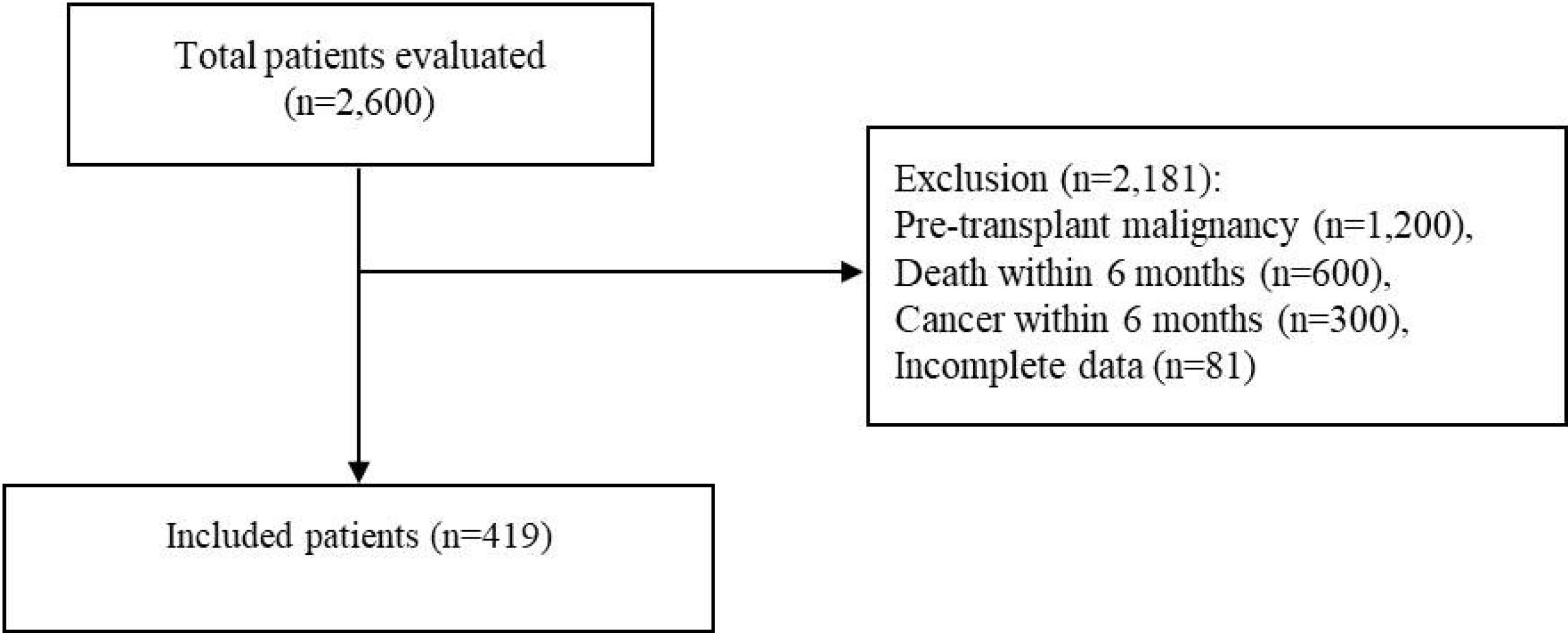
Figure 1.
Study Selection Process
.
Study Selection Process
Table 1.
Patients’ Demographic and Clinical Characteristics
|
Variable
|
Total (n=419)
|
Dead (n=127)
|
Alive (n=292)
|
P
value*
|
With
de novo
malignancy (n=53)
|
Without
de novo
malignancy (n=366)
|
P
value†
|
| Sex, n (%) |
|
|
|
|
|
|
|
| Male |
217 (51.8) |
70 (55.1) |
147 (50.3) |
0.369a |
33 (62.3) |
184 (50.3) |
0.103a |
| Female |
202 (48.2) |
57 (44.9) |
145 (49.7) |
20 (37.3) |
182 (49.7) |
| Graft type, n (%) |
|
|
|
|
|
|
|
| Whole organ |
395 (94.3) |
120 (94.5) |
275 (94.2) |
0.900a |
51 (96.2) |
344 (94.0) |
0.754b |
| Split |
24 (5.7) |
7 (5.5) |
17 (5.8) |
2 (3.8) |
22 (6.0) |
| Cause of liver disease, n (%)‡ |
|
|
0.715a |
|
|
0.015a
|
| HBV |
82 (19.6) |
27 (24.1) |
55 (20.2) |
|
15 (29.4) |
67 (20.1) |
|
| Autoimmune hepatitis |
69 (16.5) |
18 (16.1) |
51 (18.8) |
|
5 (9.8) |
64 (19.2) |
|
| Cryptogenic |
61 (14.6) |
19 (17.0) |
42 (15.4) |
|
15 (29.4) |
46 (13.8) |
|
| PSC |
54 (12.9) |
17 (15.2) |
37 (13.6) |
|
7 (13.7) |
47 (14.1) |
|
| Wilson disease |
34 (8.1) |
10 (8.9) |
24 (8.8) |
|
2 (3.9) |
32 (9.6) |
|
| HCV |
14 (3.3) |
5 (4.5) |
9 (3.3) |
|
2 (3.9) |
12 (3.6) |
|
| NASH |
27 (6.4) |
6 (5.4) |
21 (7.7) |
|
0 (0.0) |
27 (8.1) |
|
| Budd-Chiari syndrome |
14 (3.3) |
1 (0.9) |
13 (4.8) |
|
0 (0.0) |
14 (4.2) |
|
| Combination of several causes |
29 (6.9) |
9 (8.0) |
20 (7.4) |
|
5 (9.8) |
24 (7.2) |
|
| Having diabetes, n (%) |
35 (8.4) |
12 (9.4) |
23 (7.9) |
0.593a |
4 (7.5) |
31 (8.5) |
> 0.999b |
| Having HBV, n (%) |
106 (25.3) |
43 (33.9) |
63 (21.6) |
0.008
a
|
12 (22.6) |
94 (25.7) |
0.634a |
| Having HCV, n (%) |
37 (8.8) |
14 (11.0) |
23 (7.9) |
0.297a |
3 (5.7) |
34 (9.3) |
0.603b |
| Smoking, n (%) |
35 (8.4) |
15 (11.8) |
20 (6.8) |
0.092a |
2 (3.8) |
33 (9.0) |
0.288b |
| Alcohol intake, n (%) |
25 (6.0) |
10 (7.9) |
15 (5.1) |
0.277a |
0 (0.0) |
25 (6.8) |
0.058b |
| Family history of cancer, n (%) |
38 (9.1) |
13 (10.2) |
25 (8.6) |
0.583a |
2 (3.8) |
36 (9.8) |
0.202b |
| Drugs after transplant, n (%) |
| Cyclosporine |
120 (28.6) |
44 (34.6) |
76 (26.0) |
0.073a |
18 (34.0) |
102 (27.9) |
0.359a |
| Tacrolimus |
366 (87.4) |
98 (77.2) |
268 (91.8) |
<0.001
a
|
40 (75.5) |
326 (89.1) |
0.005
a
|
| Sirolimus |
289 (69.0) |
66 (52.0) |
223 (76.4) |
<0.001
a
|
31 (58.5) |
258(70.5) |
0.078a |
| Everolimus |
57 (13.6) |
15 (11.8) |
42 (14.4) |
0.480a |
8 (15.1) |
49 (13.4) |
0.735a |
| Prednisolone |
419 (100) |
|
|
|
|
|
|
| Mycophenolate mofetil |
410 (97.9) |
126 (99.2) |
284 (97.3) |
0.288b |
53 (100) |
357 (97.5) |
0.610b |
| Azathioprine |
12 (2.9) |
6 (4.7) |
6 (2.1) |
0.132a |
6 (11.3) |
6 (1.6) |
<0.001
a
|
| Age at transplantation (year), median (IQR) |
39.00 (29.00-51.00) |
44.00 (32.00-53.00) |
37.50 (28.00-48.75) |
0.003
c
|
43.00 (37.00-52.00) |
38.00 (28.00-50.00) |
0.016
c
|
| BMI at transplantation (kg/m2), median (IQR) |
23.38 (21.83-25.22) |
23.44 (22.14-26.12) |
23.36 (21.73-25.09) |
0.303c |
23.66 (21.86-24.52) |
23.34 (21.82-25.39) |
0.893c |
| MELD score at transplantation, median (IQR) |
33.00 (29.00-37.00) |
33.00 (29.00-37.00) |
33.00 (28.00-36.00) |
0.270c |
31.00 (27.00-36.50) |
33.00 (29.00-37.00) |
0.147c |
BMI: body mass index, HBV: hepatitis B virus, HCV: hepatitis C virus, IQR: interquartile range, MELD: model for end-stage liver disease, NASH: non-alcoholic steatohepatitis, PSC: primary sclerosing cholangitis.
*Comparison between alive and dead patients.
†Comparison between patients with and without de novo malignancy.
Between groups analyses of data were conducted using (a) Chi-square, (b) Fisher’s exact test, or (c) Mann-Whitney U test.
P-value < 0.05 was considered significant. There are some missing data. Bold P values denote significant differences.
‡Other causes of liver diseases: combination of several causes (n = 29), hepatocellular carcinoma (n = 10), primary biliary cholangitis (n = 6), acute liver failure (n = 4), biliary cirrhosis (n = 3), primary nonfunction (n = 2), neuroendocrine tumor (n = 2), alcohol intake (n = 2), cholangiocarcinoma (n = 1), rejection (n = 1), alpha-1 antitrypsin deficiency (n = 1), hemochromatosis (n = 1), hemangioma (n = 1), hyperoxaluria (n = 1).
Among the included patients, 127 individuals (30.3%) died and 53 patients (12.6%) received a de novo solid malignancy diagnosis. Post-transplant lymphoproliferative disorders (37.73%), squamous cell carcinoma (13.21%), cholangiocarcinoma (9.43%), and basal cell carcinoma (9.43%) were the most prevalent diagnosed de novo solid malignancies diagnosed (Table 2).
Table 2.
Frequency of Different Type of Cancers in Patients with De Novo Malignancy
|
Type of malignancy
|
Frequency (%)
|
| Post-transplant lymphoproliferative disorders |
20 (37.73) |
| Squamous cell carcinoma |
7 (13.21) |
| Cholangiocarcinoma |
5 (9.43) |
| Basal Cell Carcinoma |
5 (9.43) |
| Lung cancer |
3 (5.66) |
| Non-Hodgkin lymphoma |
2 (3.77) |
| Colon cancer |
2 (3.77) |
| Kaposi sarcoma |
2 (3.77) |
| Germ cell tumor |
2 (3.77) |
| Thyroid cancer |
1 (1.87) |
| Prostate cancer |
1 (1.87) |
| Breast cancer |
1 (1.87) |
| Gastric adenocarcinoma |
1 (1.87) |
When comparing the characteristics of alive and deceased patients, we observed that the patients who were alive had a lower age (P value = 0.003) and a lower prevalence of hepatitis B virus (21.6% vs. 33.9%, P value = 0.008), but a higher intake of tacrolimus (91.8% vs. 77.2%, P value < 0.001) and sirolimus (76.4% vs. 52%, P value < 0.001) compared to deceased patients. Furthermore, in the comparison between patients with and without de novo solid malignancies, significant differences were found in terms of etiology of liver disease (P value = 0.015), age (P-value = 0.016), as well as the use of tacrolimus (P value = 0.005) and azathioprine (P value < 0.001) (Table 1).
The mean survival time was 175.72 months (95% CI: 165.93-185.52) for survival rate and 210.06 months (95% CI: 201.61-218.52) for de novo malignancy, according to the Kaplan-Meier method (the median survival period was 116.50 months). The life-table analysis demonstrated that the 1-, 5-, 10-, 15-, and 20-year survival rates of patients were 85%, 76%, 69%, 61%, and 58%, respectively. Furthermore, the 1-, 5-, 10-, 15-, and 20-year proportion of patients free from de novo malignancy were 97%, 90%, 83%, 78%, and 78%. According to the Log-Rank test, the survival rate was significantly lower among patients with hepatitis B (P value = 0.019) and those not using tacrolimus (P value = 0.003) or sirolimus (P value < 0.001) than their respective counterparts (Figure 2). Additionally, there were notable differences in the proportion of patients free from de novo malignancy between those who used tacrolimus (P value = 0.007) or azathioprine (P value < 0.001) compared to patients who did not use these medications (Figure 3).
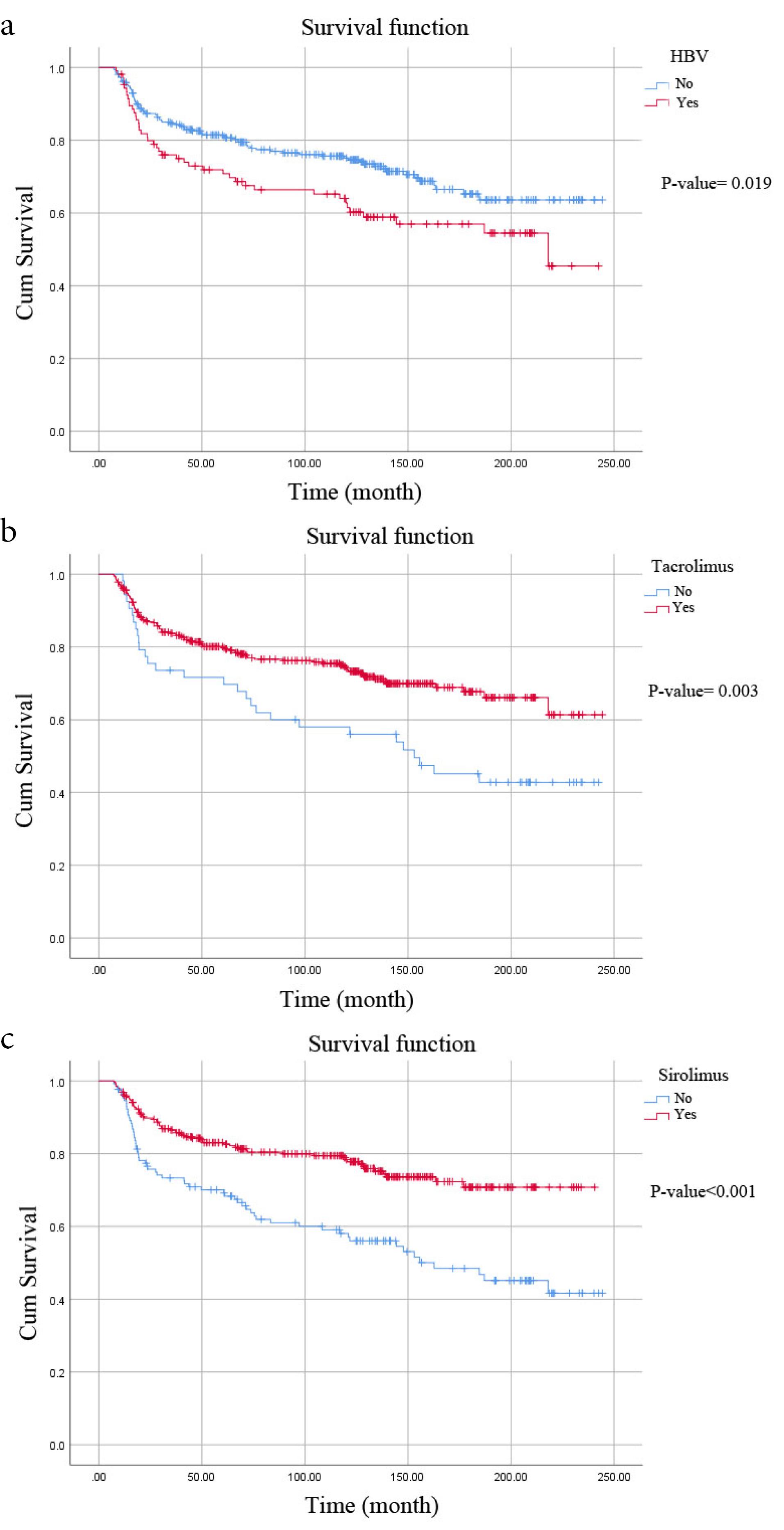
Figure 2.
Comparison of Survival Rate According to Hepatitis B Virus Status (A), Tacrolimus Intake (B), and Sirolimus Intake (C)
.
Comparison of Survival Rate According to Hepatitis B Virus Status (A), Tacrolimus Intake (B), and Sirolimus Intake (C)
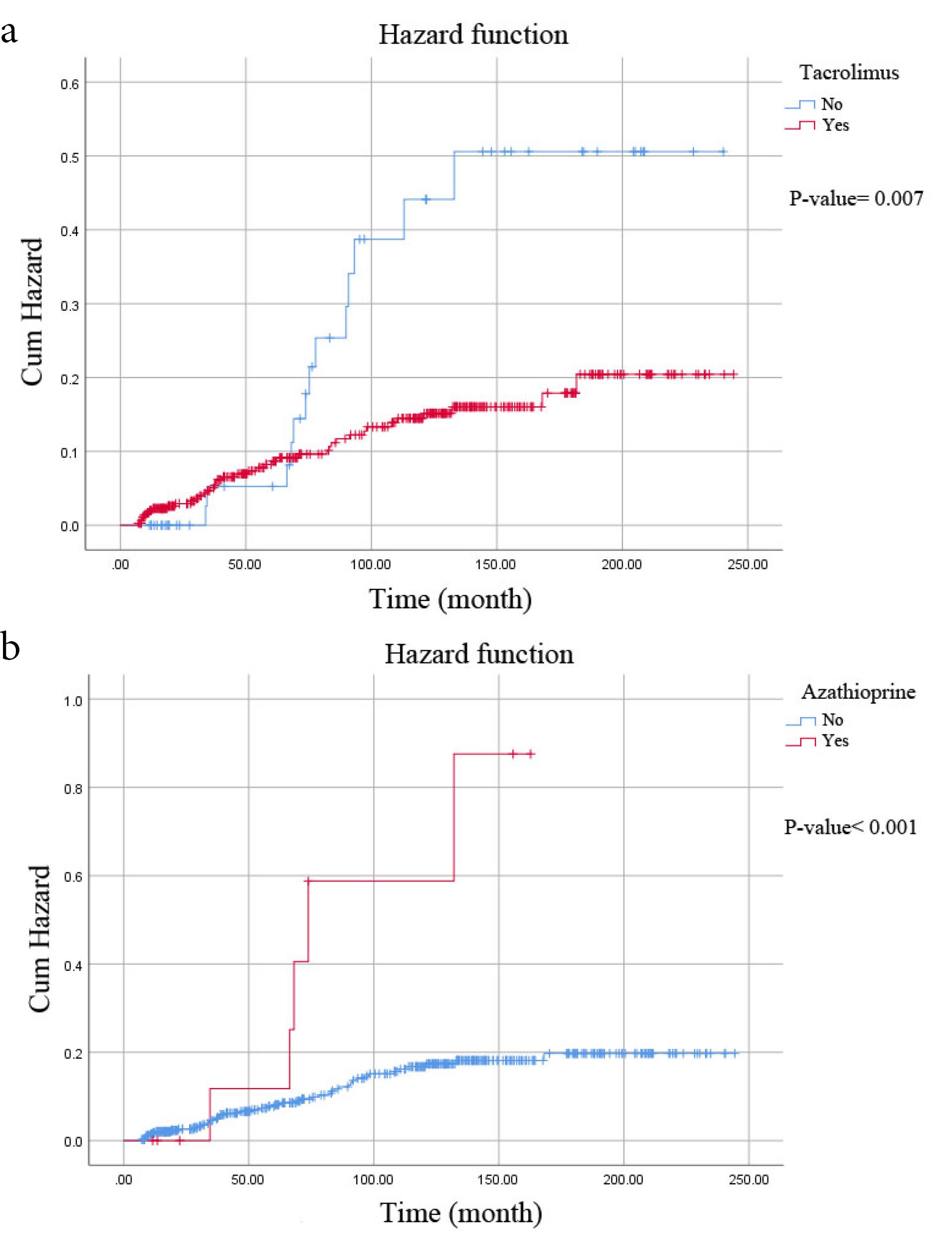
Figure 3.
Comparison of time to de novo malignancy according to the Tacrolimus intake (A) and Azathioprine intake (B)
.
Comparison of time to de novo malignancy according to the Tacrolimus intake (A) and Azathioprine intake (B)
The Cox regression model indicated that age at transplantation was associated with poorer survival (HR = 1.03, 95% CI: 1.02 to 1.05, P value < 0.001), whereas sirolimus intake was identified as a significant predictor of better survival (HR = 0.44, 95% CI: 0.31-0.63, P value < 0.001). Furthermore, age (HR = 1.05, 95% CI: 1.02-1.07, P value < 0.001) and azathioprine (HR = 5.85, 95% CI: 2.47-13.87, P value < 0.001) were significantly linked to an increased risk of de novo solid malignancy (Table 3).
Table 3.
Multivariable Cox Regression Model for Predictors of All-Causes Mortality and De Novo Malignancy Following Liver Transplantation
|
Variables
|
HR (95% CI)
|
P
value
|
| Death* |
|
|
| Age at transplantation (continuous) |
1.03 (1.01 to 1.04) |
< 0.001 |
| Sirolimus (yes vs. no) |
0.44 (0.31-0.63) |
< 0.001 |
|
De novo malignancy† |
|
|
| Age at transplantation (continuous) |
1.05 (1.02 to 1.07) |
< 0.001 |
| Azathioprine (yes vs. no) |
5.85 (2.47 to 13.87) |
< 0.001 |
HR: hazard ratio, CI: Confidence Interval.
*Age, sex, smoking, body mass index, sirolimus, tacrolimus intake, and hepatitis B virus were included in the backward Cox.
†Age, sex, body mass index, and sirolimus, azathioprine, and tacrolimus intake were included in the backward Cox regression. Only the above variables remained in the final model. P-value < 0.05 was considered significant.
Interaction tests for age and medication use showed no significant interactions (P > 0.05), indicating consistent effects across age groups. Subgroup analyses by sex and transplant indication also showed no significant differences.
Discussion
During our study period, 30.3% of the included patients died. The survival rate in the current analysis was almost similar to that reported in a previous meta-analysis study in Asia, which indicated one, two, three, five, and ten-year survival rates following liver transplantation at 85%, 80%, 75%, 73%, and 71%, respectively.13 Additionally, studies conducted in other regions reported similar estimations.14 Furthermore, we identified that patient age and sirolimus intake were predictors of patient survival following liver transplant in the multivariable model. Specifically, sirolimus use was associated with a 56% reduction in the mortality risk. Our findings are consistent with a recent meta-analysis indicating older recipients to have an increased mortality risk following liver transplant due to non-alcoholic steatohepatitis.15 Concerning sirolimus, a mammalian target of rapamycin inhibitor, Yan et al reported prolonged overall survival following sirolimus- or everolimus-based immunosuppression after liver transplantation for hepatocellular carcinoma in their pooled analyses of randomized controlled trials and cohort studies.16 The observed effects of sirolimus could be due to its beneficial effects on renal function, post-transplant hypertension, and antitumor activity.17,18 However, sirolimus is reported to have null or even detrimental effects on the survival rate in patients after liver transplantation for hepatitis.19,20 Contrary to our findings, some studies have shown that body mass index, diabetes, and the Model for End-Stage Liver Disease (MELD) score are potential risk factors limiting survival after liver transplantation.15 Discrepancies across studies may be partly attributed to differences in study designs, comorbidities, and underlying hepatic diseases. Further studies should be conducted in different health states with consideration of sirolimus’s adverse effects.
One of the key findings in our study was that 12.6% of the included patients developed a de novo solid malignancy during the study period. The risk of de novo malignancy at 1-, 5-, 10-, and 20-year after liver transplantation was estimated to be 3%, 10%, 17%, and 22%, respectively. These figures were lower compared to a previous retrospective study based on the French national Agence de la Biomédecine database, which reported that 13.45% of adult liver transplant recipients developed de novo malignancies over a median follow-up period of approximately four years. Additionally, it was noted that the likelihood of de novo malignancy development after liver transplantation was 2.07% at 1 year, 13.30% at 5 years, and 28.01% at 10 years.9 In a separate study involving 174 Dutch adults, the cumulative risk for the development of de novo malignancy after liver transplantation was reported as 6%, 20%, and 55% at 5, 10 and 15 years post-transplantation, respectively.21 The variations in the rate of de novo malignancy following liver transplantation may be attributed to differences in study populations, geographical factors, underlying hepatic and associated conditions, duration of post-transplant follow-up, types of malignancies documented, methods used to identify malignancies, and the definition of de novo malignancy.
In the present study, older patients were found to have a higher risk of developing de novo solid malignancy. Age was identified as an independent predictor of de novo malignancy following liver transplantation in some previous studies9,22 but not all.23 Furthermore, azathioprine use was associated with a substantially increased risk of de novo malignancy following liver transplantation, representing a nearly 6-fold higher incidence compared to non-exposed patients. Consistent with our findings, a prior meta-analysis demonstrated that patients receiving azathioprine after solid organ transplantation had significantly greater odds of developing de novo carcinoma compared to those on mycophenolate.6 Various mechanisms have been proposed to explain these observations. The carcinogenic effects of azathioprine may be attributed to its immunosuppressive actions on T cells and macrophages, its potential to induce mutations in human cells, and its interference with DNA repair mechanisms.24 Further studies are warranted to elucidate the underlying mechanisms more comprehensively.
Our center is one of the largest liver transplant centers in the world, providing a unique opportunity to evaluate long-term outcomes with good generalizability. However, our study had several limitations, including the retrospective design, single-center design with low generalizability, lack of time-updated exposure modeling, absence of cause-specific mortality data, small number of events that limits subgroup analyses, and inclusion of patients with various types of liver disease. Furthermore, the exact dose and duration of medications were inconsistently documented and thus not analyzed.
In conclusion, 12.6% of the included patients developed a de novo malignancy during the study period. Post-transplant lymphoproliferative disorders were found to be the most prevalent malignancy. Age and immunosuppressive regimen were independently associated with mortality and malignancy development following liver transplantation. Our findings highlight the need for further studies to evaluate potential benefits of screening strategies in high-risk recipients.
Competing Interests
The authors declare that they have no competing interests.
Data Availability Statement
Data supporting the results of this study is available from the author, upon reasonable request.
Ethical Approval
This study was performed in line with the principles of the Declaration of Helsinki. Approval was granted by the Ethics Committee of Shiraz University of medical sciences, Shiraz, Iran (Code: IR.SUMS.MED.REC.1402.436). Informed consent was obtained from all individual participants included in the study.
Funding
This study was supported by the Vice-Chancellor for Research and Technology of Shiraz University of Medical Sciences (Code: 27788). The funder had no role in the study design, analysis, decision to publish, or preparation of the manuscript.
References
- National Institutes of Health Consensus Development Conference Statement: liver transplantation--June 20-23, 1983. Hepatology 1984;4(1 Suppl):107S-10S. doi: 10.1002/hep.1840040725.
- Terrault NA, Francoz C, Berenguer M, Charlton M, Heimbach J. Liver transplantation 2023: status report, current and future challenges. Clin Gastroenterol Hepatol 2023; 21(8):2150-66. doi: 10.1016/j.cgh.2023.04.005 [Crossref] [ Google Scholar]
- Malek-Hosseini SA, Jafarian A, Nikeghbalian S, Poustchi H, Bagheri Lankarani K, Nasiri Toosi M. Liver transplantation status in Iran: a multi-center report on the main transplant indicators and survival rates. Arch Iran Med 2018; 21(7):275-82. [ Google Scholar]
- Durand F. How to improve long-term outcome after liver transplantation?. Liver Int 2018; 38 Suppl 1:134-8. doi: 10.1111/liv.13651 [Crossref] [ Google Scholar]
- Serrano MT, Sabroso S, Esteban LM, Berenguer M, Fondevila C, Lorente S. Mortality and causes of death after liver transplantation: analysis of sex differences in a large nationwide cohort. Transpl Int 2022; 35:10263. doi: 10.3389/ti.2022.10263 [Crossref] [ Google Scholar]
- Zwart ES, Yüksel E, Pannekoek A, de Vries R, Mebius RE, Kazemier G. De novo carcinoma after solid organ transplantation to give insight into carcinogenesis in general-a systematic review and meta-analysis. Cancers (Basel) 2021; 13(5):1122. doi: 10.3390/cancers13051122 [Crossref] [ Google Scholar]
- Carenco C, Faure S, Ursic-Bedoya J, Herrero A, Pageaux GP. Solid, non-skin, post-liver transplant tumors: key role of lifestyle and immunosuppression management. World J Gastroenterol 2016; 22(1):427-34. doi: 10.3748/wjg.v22.i1.427 [Crossref] [ Google Scholar]
- Hsiao CY, Lee PH, Ho CM, Wu YM, Ho MC, Hu RH. Post-transplant malignancy in liver transplantation: a single center experience. Medicine (Baltimore) 2014; 93(28):e310. doi: 10.1097/md.0000000000000310 [Crossref] [ Google Scholar]
- Altieri M, Sérée O, Lobbedez T, Segol P, Abergel A, Blaizot X. Risk factors of de novo malignancies after liver transplantation: a French national study on 11004 adult patients. Clin Res Hepatol Gastroenterol 2021; 45(4):101514. doi: 10.1016/j.clinre.2020.07.019 [Crossref] [ Google Scholar]
- Bhat M, Mara K, Dierkhising R, Watt KD. Gender, race and disease etiology predict de novo malignancy risk after liver transplantation: insights for future individualized cancer screening guidance. Transplantation 2019; 103(1):91-100. doi: 10.1097/tp.0000000000002113 [Crossref] [ Google Scholar]
- Definitive Healthcare. Top Liver Transplant Hospitals by Number of Procedures. 2025. Available from: https://www.definitivehc.com/resources/healthcare-insights/top-hospitals-performing-liver-transplants. Accessed July 2025.
- Malek-Hosseini SA, Habibzadeh F, Nikeghbalian S. Shiraz organ transplant center: the largest liver transplant center in the world. Transplantation 2019; 103(8):1523-5. doi: 10.1097/tp.0000000000002581 [Crossref] [ Google Scholar]
- Ghelichi-Ghojogh M, Rajabi A, Mohammadizadeh F, Shojaie L, Vali M, Afrashteh S. Survival rate of liver transplantation in Asia: a systematic review and meta-analysis. Iran J Public Health 2022; 51(10):2207-20. doi: 10.18502/ijph.v51i10.10979 [Crossref] [ Google Scholar]
- Yang LS, Shan LL, Saxena A, Morris DL. Liver transplantation: a systematic review of long-term quality of life. Liver Int 2014; 34(9):1298-313. doi: 10.1111/liv.12553 [Crossref] [ Google Scholar]
- Minich A, Arisar FAQ, Shaikh NS, Herman L, Azhie A, Orchanian-Cheff A. Predictors of patient survival following liver transplant in non-alcoholic steatohepatitis: a systematic review and meta-analysis. EClinicalMedicine 2022; 50:101534. doi: 10.1016/j.eclinm.2022.101534 [Crossref] [ Google Scholar]
- Yan X, Huang S, Yang Y, Lu Z, Li F, Jiang L. Sirolimus or everolimus improves survival after liver transplantation for hepatocellular carcinoma: a systematic review and meta-analysis. Liver Transpl 2022; 28(6):1063-77. doi: 10.1002/lt.26387 [Crossref] [ Google Scholar]
- Harper SJ, Gelson W, Harper IG, Alexander GJ, Gibbs P. Switching to sirolimus-based immune suppression after liver transplantation is safe and effective: a single-center experience. Transplantation 2011; 91(1):128-32. doi: 10.1097/tp.0b013e3181fe131b [Crossref] [ Google Scholar]
- Uhlmann D, Weber T, Ludwig S, Ludwig B, Bartels M, Hauss J. Long-term outcome of conversion to sirolimus monotherapy after liver transplant. Exp Clin Transplant 2012; 10(1):30-8. doi: 10.6002/ect.2011.0086 [Crossref] [ Google Scholar]
- Sheng L, Jun S, Jianfeng L, Lianghui G. The effect of sirolimus-based immunosuppression vs conventional prophylaxis therapy on cytomegalovirus infection after liver transplantation. Clin Transplant 2015; 29(6):555-9. doi: 10.1111/ctr.12552 [Crossref] [ Google Scholar]
- Watt KD, Dierkhising R, Heimbach JK, Charlton MR. Impact of sirolimus and tacrolimus on mortality and graft loss in liver transplant recipients with or without hepatitis C virus: an analysis of the Scientific Registry of Transplant Recipients Database. Liver Transpl 2012; 18(9):1029-36. doi: 10.1002/lt.23479 [Crossref] [ Google Scholar]
- Haagsma EB, Hagens VE, Schaapveld M, van den Berg AP, de Vries EG, Klompmaker IJ. Increased cancer risk after liver transplantation: a population-based study. J Hepatol 2001; 34(1):84-91. doi: 10.1016/s0168-8278(00)00077-5 [Crossref] [ Google Scholar]
- Chatrath H, Berman K, Vuppalanchi R, Slaven J, Kwo P, Tector AJ. De novo malignancy post-liver transplantation: a single center, population-controlled study. Clin Transplant 2013; 27(4):582-90. doi: 10.1111/ctr.12171 [Crossref] [ Google Scholar]
- Abdel-Wahab M, Abdel-Khalek EE, Elshoubary M, Yassen AM, Salah T, Sultan AM. Predictive factors of DE Novo malignancies after living-donor liver transplantation: a single-center experience. Transplant Proc 2021; 53(2):636-44. doi: 10.1016/j.transproceed.2021.01.033 [Crossref] [ Google Scholar]
- Nguyen T, Vacek PM, O’Neill P, Colletti RB, Finette BA. Mutagenicity and potential carcinogenicity of thiopurine treatment in patients with inflammatory bowel disease. Cancer Res 2009; 69(17):7004-12. doi: 10.1158/0008-5472.Can-09-0451 [Crossref] [ Google Scholar]