Arch Iran Med. 28(9):514-521.
doi: 10.34172/aim.34530
Original Article
Impact of Ambient PM₁₀ and SO₂ Levels on Intensive Care Unit Admissions Due to Cardiopulmonary Diseases in a Tertiary Care Hospital
Melike Yüksel Yavuz Conceptualization, Data curation, Formal analysis, Investigation, Methodology, Project administration, Resources, Software, Supervision, Validation, Visualization, Writing – original draft, Writing – review & editing, 1, * 
Hüseyin Döngelli Conceptualization, Data curation, Formal analysis, Investigation, Methodology, Project administration, Resources, Software, Supervision, Validation, Visualization, Writing – original draft, Writing – review & editing, 2
Mehmet Yavuz Conceptualization, Data curation, Formal analysis, Investigation, Methodology, Project administration, Resources, Software, Supervision, Validation, Visualization, Writing – original draft, Writing – review & editing, 3
Adem Şahin Project administration, Resources, Software, Supervision, Validation, Visualization, Writing – original draft, Writing – review & editing, 3
Murat Güneş Project administration, Resources, Software, Supervision, Validation, Visualization, Writing – original draft, Writing – review & editing, 3
Işıl Köse Güldoğan Project administration, Resources, Software, Supervision, Validation, Visualization, Writing – original draft, Writing – review & editing, 3
Nimet Şenoğlu Project administration, Resources, Software, Supervision, Validation, Visualization, Writing – original draft, Writing – review & editing, 3
Author information:
1Katip Celebi University, Faculty of Medicine, Pulmonology Department, Izmir, Turkiye
2Buca Seyfi Demirsoy Training and Research Hospital, Internal Medicine Department, Izmir, Turkiye
3Tepecik Training and Research Hospital, Intensive Care Department, Izmir, Turkiye
Abstract
Background:
Ambient air pollution, especially particulate matter (PM₁₀) and sulfur dioxide (SO₂), has been implicated in exacerbating cardiopulmonary diseases. While emergency department visits have been widely studied, the impact of pollution on intensive care unit (ICU) admissions and mortality is less understood. This retrospective observational study aimed to evaluate the association between monthly air pollutant levels and ICU admissions for cardiopulmonary conditions, as well as in-hospital mortality.
Methods:
We retrospectively analyzed 6,112 ICU admissions in a tertiary hospital from January 2012 to November 2019. Using defined inclusion criteria, 227 pulmonary and 344 cardiovascular ICU admissions were selected. Monthly PM₁₀ and SO₂ levels were obtained from official air monitoring stations. A one-month lag model was applied for cardiovascular admissions. Multivariate models were used to assess associations, and results were reported with 95% confidence intervals (CIs).
Results:
Higher PM₁₀ levels were significantly associated with pulmonary ICU admissions (β=0.017; 95% CI: 0.003–0.031; P=0.020) and with cardiovascular admissions using a one-month lag structure (β=0.018; 95% CI: 0.005–0.030; P=0.006). SO₂ showed no significant associations. No significant relationship was observed between air pollution and in-hospital mortality. Chronic kidney disease (HR=1.309; 95% CI: 1.031–1.663; P=0.027) and higher Simplified Acute Physiology Score (SAPS) scores (HR=1.012; 95% CI: 1.006–1.017; P<0.001) were independent mortality predictors.
Conclusion:
This study indicates that long-term exposure to PM₁₀ significantly affects ICU hospitalization rates for both pulmonary and cardiac conditions, particularly reflecting delayed effects in cardiovascular admissions, without a corresponding impact on in-hospital mortality.
Keywords: Air pollution, Intensive care unit, In-hospital mortality, Particulate matter, Sulfur dioxide
Copyright and License Information
© 2025 The Author(s).
This is an open-access article distributed under the terms of the Creative Commons Attribution License (
https://creativecommons.org/licenses/by/4.0), which permits unrestricted use, distribution, and reproduction in any medium, provided the original work is properly cited.
Cite this article as: Yüksel Yavuz MY, Döngelli H, Yavuz M, Şahin A, Güneş M, Güldoğan IK, et al. Impact of ambient PM₁₀ and SO₂ levels on intensive care unit admissions due to cardiopulmonary diseases in a tertiary care hospital.. Arch Iran Med. 2025;28(9):514-521. doi: 10.34172/aim.34530
Introduction
Air pollution is among the most significant environmental factors with substantial short- and long-term adverse effects on human health.1 Particulate matter with a diameter of 10 micrometers or smaller (PM10) and sulfur dioxide (SO2) are among the most concerning air pollutants due to their pervasive occurrence and well-documented associations with negative health effects.These substances have been shown to worsen chronic illnesses, provoke acute medical events, and contribute to higher rates of hospital admissions, especially in high-risk groups such as older adults and individuals with underlying health conditions.2
Multiple factors, such as pollutant concentration, length of exposure, seasonal fluctuations, and presence of comorbidities, can influence the impact of air pollution on human health.3 Although numerous studies have assessed how air pollution affects emergency room visits and overall hospital admissions, limited research has specifically addressed its association with admissions to intensive care units (ICUs), which often represent more critical clinical conditions.4-6 Extensive epidemiological research has linked both short- and long-term exposure to PM10 and SO2 with a heightened risk of developing respiratory conditions such as asthma, chronic obstructive pulmonary disease (COPD), and pneumonia.7,8 Likewise, exposure to air pollutants has been associated with adverse cardiovascular events, including heart failure, ischemic heart disease, and arrhythmias.9 While several studies have explored the association between air pollution and ICU admissions, as well as in-hospital mortality, the nature of this relationship remains insufficiently understood.10,11
Moreover, the biological plausibility of pollutant-related ICU admissions is supported by several mechanistic studies. PM10 and SO2 have been shown to induce oxidative stress, systemic inflammation, endothelial dysfunction, and autonomic imbalance, all of which can precipitate acute respiratory or cardiovascular decompensation requiring ICU care.12 As one of the world’s megacities, Tehran, Iran, experiences significant seasonal variations in pollutant levels, particularly during the colder months, due to atmospheric inversion combined with heavy traffic and urban-industrial emissions. According to statistics from the Iranian Ministry of Health, ischemic heart disease and respiratory illnesses consistently rank among the leading causes of hospitalization and mortality.13,14 We hypothesized that monthly exposure to air pollutants, specifically PM10 and SO2, may influence ICU admissions due to pulmonary or cardiovascular events. This study aimed to investigate this potential association and to identify factors related to in-hospital mortality.
Patients and Methods
Patients and Data Collection
This retrospective observational single-center study was conducted using data from patients who were admitted to the ICU between January 2012 and November 2019. A total of 6,112 ICU admissions were initially reviewed, from which 227 patients with pulmonary conditions and 344 patients with cardiovascular conditions were selected for analysis. Pulmonary ICU admissions were defined based on ICD-10 codes J12–J18 (pneumonia), J44 (COPD), and J80 (ARDS). Diagnoses were confirmed by attending physicians and coded within the hospital information system. The inclusion criteria focused on adult patients (aged 18 years and older) who were diagnosed with either pulmonary or cardiac conditions and who required ICU care during the specified study period. The exclusion criteria included patients with incomplete clinical data, trauma cases, sepsis-related ICU admissions, surgical ICU cases, and individuals under 18 years of age at the time of admission. Patient clinical data, including demographic information (age and sex), comorbidities, prescribed medications, reasons for ICU admission, and routine laboratory test results, were retrieved from the hospital’s electronic health records system. The database used for data collection was maintained by the hospital’s Information management system, which ensured accurate and comprehensive data retrieval.
The pulmonary conditions included in the analysis were primarily pneumonia, COPD, and acute respiratory distress syndrome (ARDS), while the cardiac conditions primarily consisted of congestive heart failure, acute coronary syndrome, and arrhythmias. The severity of illness at the time of ICU admission was assessed using the Simplified Acute Physiology Score II (SAPS II), a validated tool for predicting mortality and morbidity in critically ill patients. Monthly average concentrations of PM10 (µg/m³) and SO2 (ppm) were obtained from the İzmir Metropolitan Municipality Air Quality Monitoring System, specifically from the station closest to the hospital (within a 20-km radius). Data were derived from two continuous monitoring stations with > 95% data completeness. Missing daily values ( < 2%) were imputed using linear interpolation.
To investigate temporal dynamics, lag structures were defined as lag 0 (same month), lag 1 (previous month), and lag 2 (two months prior). The final analysis focused on lag 1, based on prior literature suggesting delayed inflammatory responses to pollution exposure. This study was reported in accordance with the STROBE (Strengthening the Reporting of Observational Studies in Epidemiology) guidelines for observational research.
Statistical Analysis
All analyses were conducted using the Statistical Package for the Social Sciences (SPSS) version 24.0. Normality was tested using the Kolmogorov-Smirnov and Shapiro-Wilk tests. Parametric continuous variables were compared with Student’s T test, while the Mann-Whitney U test was used for non-parametric continuous variables. Results were presented as mean ± standard deviation (SD) and median (interquartile range). Categorical variables were compared using the Chi-Square and Fisher’s exact tests, with results reported as n (%). This study aimed to investigate the relationship between air pollution levels (PM10 and SO2) and monthly ICU admission rates using a generalized linear model. Data on air pollution levels and ICU admissions were collected over an eight-year period (2012–2019). Monthly averages of PM10 (µg/m³) and SO2 (ppm) were used for the independent variables, while the total number of ICU admissions per month was the dependent variable. To examine the delayed effects of air pollution, lagged values of PM10 and SO2 from the previous month were included in the model. Pulmonary and cardiac ICU hospitalization rates were analyzed as separate dependent variables. In-hospital mortality was assessed using Cox regression and Kaplan-Meier analyses. The relationship between air pollution (PM10 and SO2) and monthly ICU admissions was assessed using a generalized linear regression model with a log-link function, assuming a Poisson distribution, appropriate for count data. Model diagnostics, including deviance, overdispersion, and residual analysis, were evaluated. Covariates adjusted for included age, sex, and seasonality (warm vs. cold months). Statistical significance was determined using p-values, with a threshold of 0.05. Confidence intervals (CIs) were reported at the 95% level for all effect estimates.
Results
Clinical Characteristics of Study Group
This study involved 571 patients with a median age of 70 years, 60% of whom were female. During the study period, all patients ICU admissions were recorded, of which 227 (40%) were due to pulmonary conditions and 344 (60%) due to cardiac conditions. The median duration of ICU hospitalization was 8 days. The most frequent diagnoses were pneumonia (32.6%), congestive heart failure (28.9%), and acute coronary syndrome (15.9%). Cardiovascular disease (33.3%) and diabetes mellitus (27.7%) were the most common comorbidities. The ICU mortality rate was 41.1%, while in-hospital mortality was 36.2% (Table 1).
Table 1.
Demographic and Clinical Characteristics of Patients
|
|
Total (n=571)
|
| Age median (IQR) |
70 (60‒79) |
| Gender n (%) |
|
| Female |
342 (60) |
| Male |
229 (40) |
| Hospitalization duration days median (IQR) |
8 (3‒23) |
| SAPS II score median (IQR) |
59 (47.25‒72) |
| Laboratory findings median (IQR) |
|
| Creatinine |
1.4 (1.1‒2.5) |
| Albumin |
2.9 (2.5‒3.4) |
| WBC |
14.9 (11.1‒19.9) |
| CRP |
76.1 (25.3‒165.7) |
| Procalcitonin |
1.41 (0.36‒7.75) |
| Diagnosis n (%) |
|
| Pneumonia |
186 (32.6) |
| COPD exacerbation |
51 (8.9) |
| Pulmonary embolism |
8 (1.4) |
| Congestive heart failure |
165 (28.9) |
| Acute coronary syndrome |
91 (15.9) |
| Other causes |
70 (12.3) |
| Comorbidities n (%) |
|
| Cardiovascular disease |
190 (33.3) |
| COPD |
98 (17.2) |
| Diabetes mellitus |
158 (27.7) |
| Chronic kidney disease |
89 (15.5) |
| Cerebrovascular accident |
37 (6.5) |
| Malignancy |
34 (6) |
| Admission origin n (%) |
|
| Emergency room |
168 (29.4) |
| Wards |
254 (44.5) |
| Other |
149 (26.1) |
| Mortality n (%) |
|
| Intensive care unit |
235 (41.1) |
| In-hospital |
207 (36.2) |
COPD, Chronic obstructive pulmonary disease; CRP, C-reactive protein; IQR, Interquartile range; SAPS II, Simplified acute physiology score; WBC, White blood cell.
Comparison of Pulmonary and Cardiac Admissions
Pulmonary patients (n = 227) had a median age of 69, while cardiac patients (n = 344) had a median age of 70 (P = 0.922), with no significant gender differences (P = 0.596). Pulmonary patients had longer ICU hospitalization (11 days vs. 7 days, P = 0.009) and higher SAPS II scores (60.2 vs. 60, P = 0.003). Significant differences were found in albumin (P < 0.001) and CRP levels (P < 0.001), with pulmonary patients having lower albumin and higher CRP. Pulmonary patients had higher rates of COPD (28.2% vs. 9.9%, P < 0.001) and chronic kidney disease (CKD) (52.9% vs. 49.1%, P = 0.382), while cardiac patients had more cardiovascular disease (50.6% vs. 7%, P < 0.001). Mortality rates were significantly higher in cardiac patients (88.1% vs. 75.3%, P < 0.001). SO2 levels were comparable between pulmonary and cardiac patient groups (median 9 ppm, IQR: 4), and the difference was not statistically significant (P = 0.982). This suggests that SO2 exposure did not differ between groups and may not have had a differential impact based on disease type. Similarly, PM10 levels were slightly higher in the pulmonary group compared to the cardiac group (median 42 µg/m³ vs. 39 µg/m³), but this difference was also not statistically significant (P = 0.280). While mean exposure levels did not vary significantly between groups, the significant associations observed in regression analyses suggest that the health effects of PM10 may be more closely related to temporal variability and lag effects rather than average concentrations alone (Table 2). The rate of patients hospitalized in intensive care for pulmonary and cardiac causes over multiple sessions is shown in Figure 1.
Table 2.
Demographic and Clinical Characteristics of Patients
|
|
Pulmonary (
n
=227)
|
Cardiac (
n
=344)
|
P
value
|
| Age median (IQR) |
69 (22) |
70 (19) |
0.922 |
| Gender n (%) |
|
|
0.596 |
| Female |
88 (38.8) |
141 (41) |
|
| Male |
139 (61.2) |
203 (59) |
|
| Hospitalization duration days median (IQR) |
11 (22) |
7 (17) |
0.009 |
| SAPS II score median (IQR) |
60.2 (14) |
60 (13) |
0.003 |
| Laboratory findings median (IQR) |
| Creatinine mg/dL |
1.6 (1.7) |
1.4 (1.2) |
0.885 |
| Albumin g/dL |
2.7 (0.8) |
3.1 (0.9) |
< 0.001 |
| WBC 10*3 |
13.9 (9) |
15.5 (9) |
0.075 |
| CRP mg/dL |
96.7 (57.2) |
67 (120) |
< 0.001 |
| Procalcitonin IU/dL |
1.17 (6.23) |
1.71 (7.09) |
0.212 |
| Comorbidities n (%) |
|
|
|
| Cardiovascular disease |
16 (7) |
174 (50.6) |
< 0.001 |
| COPD |
64 (28.2) |
34 (9.9) |
< 0.001 |
| Diabetes mellitus |
86 (37.9) |
73 (21.2) |
< 0.001 |
| Chronic kidney disease |
120 (52.9) |
169 (49.1) |
0.382 |
| Cerebrovascular accident |
23 (10.1) |
14 (4.1) |
0.004 |
| Malignancy |
28 (12.3) |
6 (1.7) |
< 0.001 |
| PM10 µg/m³median (IQR) |
42 (18) |
39 (14) |
0.280 |
| SO2 ppmmedian (IQR) |
9 (4) |
9 (4) |
0.982 |
| Mortality n(%) |
171 (75.3) |
303 (88.1) |
< 0.001 |
COPD, Chronic obstructive pulmonary disease; CRP, C-reactive protein; IQR, Interquartile range; SAPS II, Simplified acute physiology score; WBC, White blood cell; PM10, Particulate matter 10 micrometers or less in diameter; SO2, Sulfur dioxide.
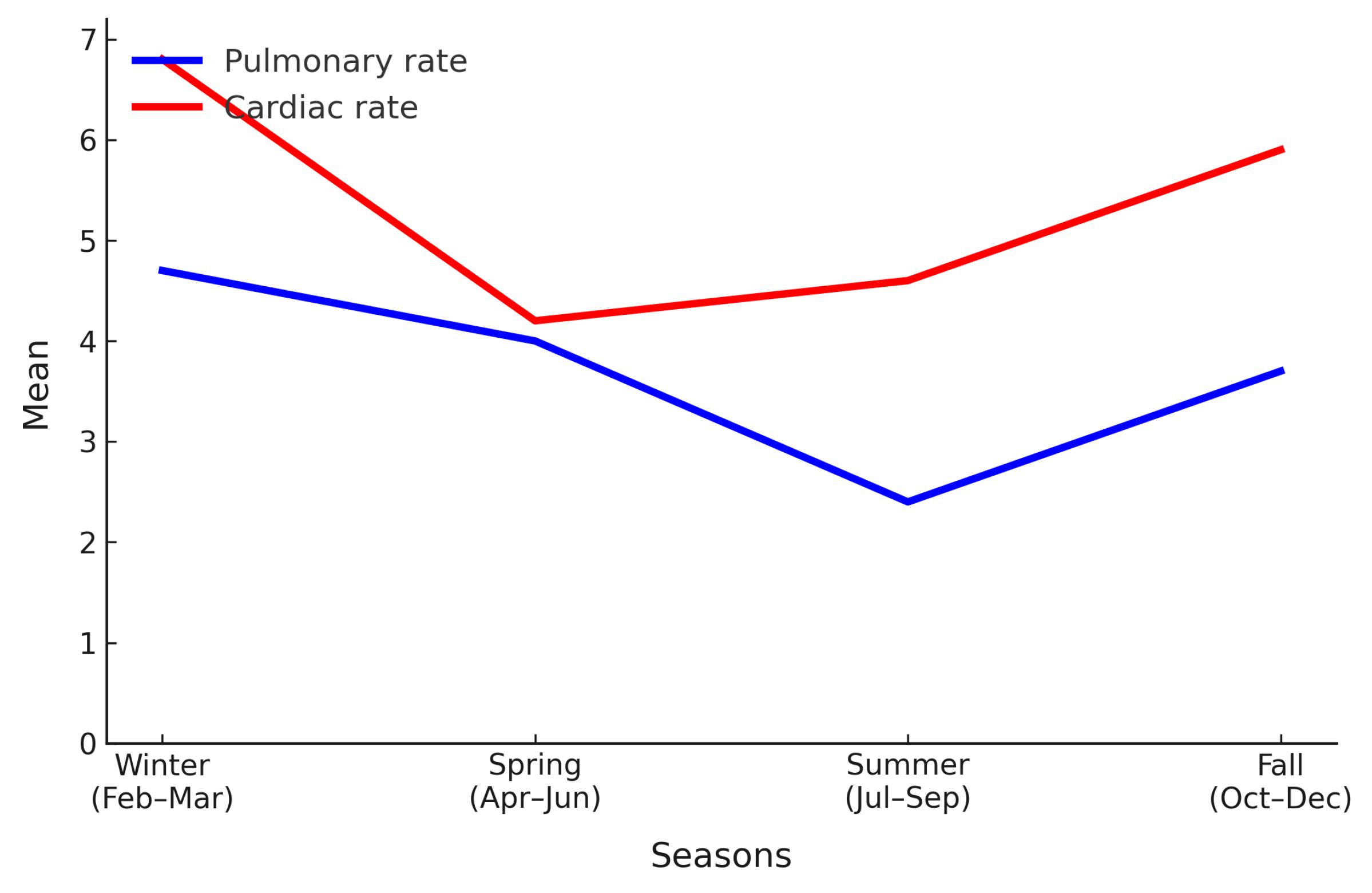
Figure 1.
Rate of Hospitalized Patients in the ICU Due to Pulmonary and Cardiac Causes Across Multiple Sessions.
.
Rate of Hospitalized Patients in the ICU Due to Pulmonary and Cardiac Causes Across Multiple Sessions.
Factors Associated with Pulmonary ICU Hospitalization Rate in Generalized Linear Models
Univariate analysis revealed that PM10 exposure was significantly associated with an increase in pulmonary ICU hospitalization rates (β = 0.014, P = 0.015), while age, SO2, and seasonal variations showed no significant effects (P > 0.05). In multivariate analysis, PM10 remained a significant factor (β = 0.017, P = 0.020), indicating a positive correlation with pulmonary ICU hospitalization rates. Additionally, a Spearman correlation analysis was performed to further assess the relationship between PM10 levels and pulmonary ICU admissions. The analysis revealed a statistically significant moderate positive correlation (r = 0.76, P = 0.004), reinforcing the association identified in the generalized linear regression model. Figure 2 illustrates the temporal association between monthly average PM10 levels (µg/m³) and the number of pulmonary ICU admissions over eight years. A parallel upward trend in PM10 concentration and pulmonary ICU admissions was observed, particularly during winter months, suggesting a potential seasonal pattern. However, age, SO2, and seasonal variations (winter, spring, summer) did not demonstrate significant associations in either the univariate or multivariate models (P > 0.05) (Table 3).
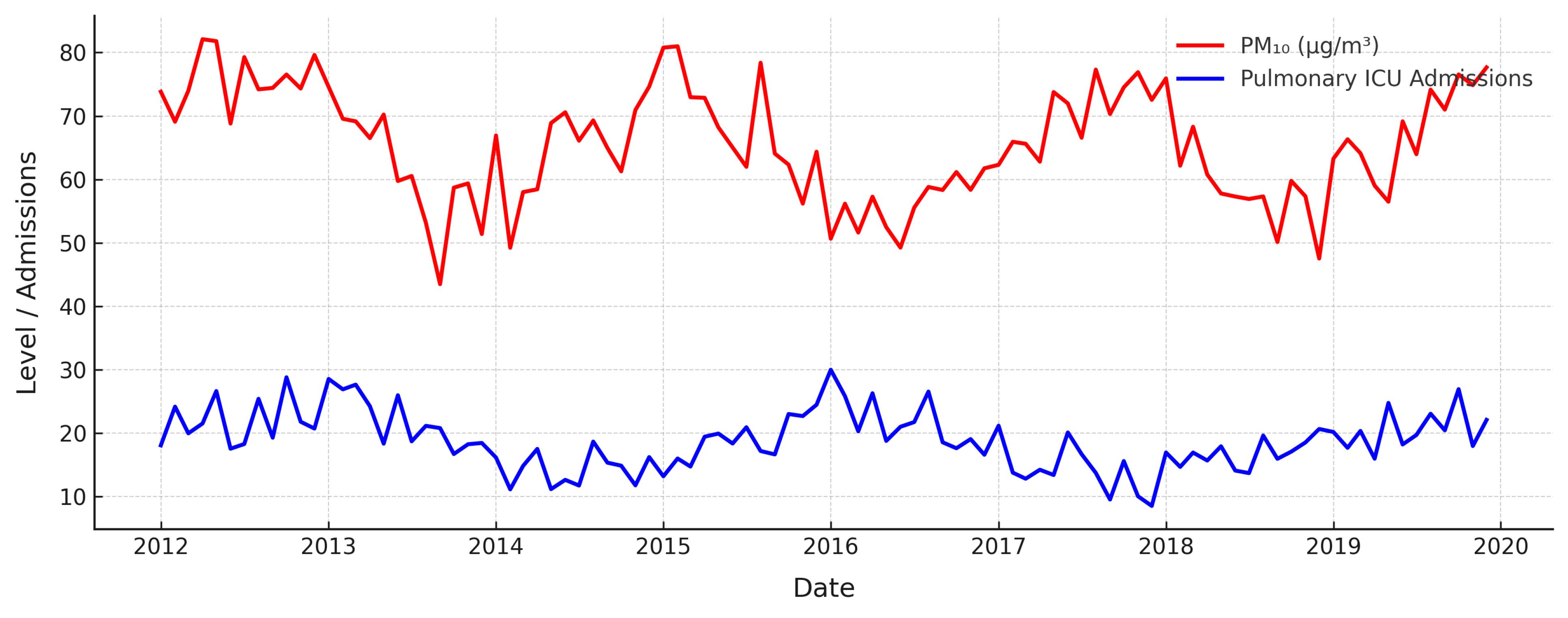
Figure 2.
Monthly PM₁₀ Levels and Pulmonary ICU Admissions
.
Monthly PM₁₀ Levels and Pulmonary ICU Admissions
Table 3.
Generalized Linear Model Analysis of Pulmonary ICU Hospitalization Rate with Related Factors
|
|
Univariate Analysis
|
Multivariate Analysis
|
|
β
|
95% CI
|
P
value
|
β
|
95% CI
|
P
value
|
| Age |
0.008 |
-0.014/0.029 |
0.480 |
0.026 |
-0.015/0.026 |
0.538 |
| PM10 (µg/m³) |
0.014 |
0.003/0.026 |
0.015 |
0.017 |
0.003/0.032 |
0.020 |
| SO2 (ppm) |
0.008 |
-0.036/0.051 |
0.725 |
-0.009 |
-0.058/0.039 |
0.704 |
| PM10 Lag1 |
0.011 |
-0.001/0.022 |
0.065 |
|
|
|
| SO2 (ppm)Lag1 |
0.007 |
-0.033/0.048 |
0.724 |
|
|
|
| Session (Winter) |
0.190 |
-0.154/0.535 |
0.279 |
0.189 |
-0.145/0.523 |
0.268 |
| Session (Spring) |
0.087 |
-0.257/432 |
0.619 |
0.322 |
-0.108/0.752 |
0.142 |
| Session (Summer) |
-0.300 |
-0.659/0.059 |
0.101 |
-0.076 |
-0.503/0.350 |
0.725 |
| Session (Fall) |
Reference |
|
|
|
|
|
CI, Confidence interval; OR, Odds ratio; PM10, Particulate matter 10 micrometers or less in diameter; SO2, Sulfur dioxide; β, Beta coefficient.
Factors Associated with Cardiac ICU Hospitalization Rate in Generalized Linear Models
In the univariate analysis, age, SO2, or seasonal variations did not show any significant associations with cardiac ICU hospitalization rates (P > 0.05). However, PM10 exposure showed a marginal association (β = 0.008, P = 0.199). In the multivariate analysis, only PM10 Lag1 (previous month’s exposure) demonstrated a significant positive relationship with cardiac ICU hospitalization rates (β = 0.018, P = 0.006). Age, SO2, and seasonal variations did not show significant associations in either analysis (P > 0.05) (Table 4).
Table 4.
Generalized linear model analysis of cardiac ICU hospitalization rate with related factors
|
|
Univariate Analysis
|
Multivariate Analysis
|
|
β
|
95% CI
|
P
value
|
β
|
95% CI
|
P
value
|
| Age |
-0.001 |
-0.020/0.019 |
0.939 |
-0.006 |
-0.026/0.013 |
0.519 |
| PM10 (µg/m³) |
0.008 |
-0.004/0.020 |
0.199 |
|
|
|
| SO2 (ppm) |
0.005 |
-0.036/0.047 |
0.804 |
-0.022 |
-0.066/0.023 |
0.337 |
| PM10 (µg/m³) Lag1 |
0.015 |
0.003-0.027 |
0.011 |
0.018 |
0.005/0.031 |
0.006 |
| SO2 (ppm)Lag1 |
0.014 |
-0.029/0.057 |
0.517 |
|
|
|
| Session (Winter) |
0.184 |
-0.159/0.529 |
0.292 |
|
|
|
| Session (Spring) |
-0.217 |
-0.568/0.134 |
0.226 |
|
|
|
| Session (Summer) |
-0.144 |
-0.490/0.203 |
0.416 |
|
|
|
| Session (Fall) |
Reference |
|
|
|
|
|
CI, Confidence interval; OR, Odds ratio; PM10, Particulate matter 10 micrometers or less in diameter; SO2, Sulfur dioxide; β, Beta coefficient.
Factors Associated with In-hospital Mortality
In the univariate analysis, age, SAPS score, cardiac diagnosis, infection, CKD, and diabetes mellitus (DM) were significantly associated with survival (P < 0.05). Specifically, older age (HR = 1.009, P = 0.008) and higher SAPS score (HR = 1.016, P< 0.001) were strong predictors of poor survival. Cardiac diagnosis also increased the risk (HR = 1.316, P = 0.004). Interestingly, infection was associated with a reduced risk of in-hospital mortality in our cohort (HR = 0.768, P = 0.004). This seemingly paradoxical result may be due to selection bias or differential ICU admission thresholds, where patients admitted with isolated infections (particularly pneumonia) may have had fewer comorbidities or better physiological reserves compared to those admitted with decompensated cardiac conditions or multi-organ failure. Additionally, infections may have prompted earlier ICU hospitalization and intervention, contributing to improved outcomes relative to other critically ill patients. In the multivariate analysis, only SAPS score (HR = 1.012, P < 0.001) and CKD (HR = 1.309, P = 0.027) remained significant predictors of survival, while the impact of age and cardiac diagnosis became non-significant. The effects of environmental factors like PM10 and SO2 exposure were not significant in either analysis (Table 5).
Table 5.
Cox Regression Analysis of Survival with Related Factors
|
|
Univariate analysis
|
Multivariate analysis
|
|
HR
|
95% CI
|
P
value
|
HR
|
95% CI
|
P
value
|
| Age |
1.009 |
1.002‒1.015 |
0.008 |
1.006 |
0.999‒1.014 |
0.116 |
| Female gender |
1.005 |
0.836‒1.208 |
0.961 |
1.027 |
0.846‒1.246 |
0.789 |
| SAPS score |
1.016 |
1.010‒1.021 |
< 0.001 |
1.012 |
1.006‒1.018 |
< 0.001 |
| Cardiac versus pulmonary |
1.316 |
1.091‒1.588 |
0.004 |
1.143 |
0.850‒1.538 |
0.375 |
| PM10 |
0.995 |
0.987‒1.002 |
0.157 |
0.995 |
0.986‒1.004 |
0.295 |
| SO2 (ppm) |
0.974 |
0.944‒1.005 |
0.105 |
0.993 |
0.956‒1.030 |
0.694 |
| PM10 (µg/m³) Lag1 |
0.996 |
0.988‒1.003 |
0.269 |
|
|
|
| SO2 (ppm)Lag1 |
0.975 |
0.946‒1.005 |
0.096 |
|
|
|
| Infection |
0.768 |
0.641‒920 |
0.004 |
0.834 |
0.647‒1.075 |
0.161 |
| CVD |
1.144 |
0.946‒1.384 |
0.167 |
1.024 |
0.814‒1.289 |
0.839 |
| COPD |
0.854 |
0.661‒1.104 |
0.228 |
0.951 |
0.724‒1.249 |
0.719 |
| CKD |
1.506 |
1.255‒1.807 |
< 0.001 |
1.309 |
1.031‒1.662 |
0.027 |
| CVA |
0.693 |
0.463‒1.037 |
0.074 |
0.927 |
0.612‒1.403 |
0.720 |
| DM |
1.336 |
1.098‒1.627 |
0.004 |
1.142 |
0.890‒1.465 |
0.298 |
| Malignancy |
1.202 |
0.825‒1.752 |
0.336 |
|
|
|
| Procalcitonin |
1.001 |
0.997‒1.003 |
0.981 |
|
|
|
| CRP |
1.001 |
0.999‒1.001 |
0.663 |
|
|
|
| WBC |
1.006 |
0.996‒1.017 |
0.249 |
1.009 |
0.998‒1.020 |
0.099 |
| Creatinine |
1.085 |
1.035–1.139 |
0.001 |
1.020 |
0.946‒1.100 |
0.600 |
| Albumin |
0.967 |
0.871‒1.072 |
0.522 |
|
|
|
CI, Confidence interval; HR, hazard ratio; SAPS, Simplified acute physiology score; PM10, Particulate matter 10 micrometers or less in diameter; SO2, Sulfur dioxide; CVD, Cardiovascular disease; COPD, Chronic obstructive pulmonary disease; CKD, Chronic kidney disease; CVA, Cerebrovascular accident; DM, Diabetes mellitus; CRP, C-reactive protein; WBC, White blood cells.
Discussion
Our findings demonstrated that long-term exposure to PM10 was significantly associated with an increased rate of pulmonary ICU admissions, both in univariate and multivariate models. Although the observed differences in PM10 exposure and ICU admission rates were statistically significant, the effect sizes also suggest clinical relevance, particularly in the context of public health policy and resource allocation for respiratory care. Similarly, lagged PM10 exposure (from the previous month) showed a significant relationship with cardiac ICU admissions, suggesting a potential delayed effect of air pollution on cardiovascular morbidity. In contrast, no significant associations were observed between SO2 levels and ICU admission rates in either diagnostic group. The differential associations observed (PM10 with both cardiac and pulmonary ICU admissions, and SO2 with no significant outcomes) may reflect the broader systemic effects of particulate matter compared to the more localized respiratory irritation caused by sulfur dioxide. Higher SAPS II scores and the presence of CKD emerged as significant predictors of in-hospital mortality, while air pollution parameters such as PM10 and SO2 were not independently associated with survival outcomes.
Previous studies have typically examined short-term exposure to air pollution, often focusing on durations measured in days. These studies have similarly reported that indicators such as SO2 and PM10 are associated with increased rates of hospital admissions and higher rates of hospitalization due to pulmonary or cardiac causes.15-18 In our study, we aimed to explore the effects of more prolonged exposure, utilizing monthly average values of air pollutants. We observed that monthly PM10 concentrations were significantly associated with increased pulmonary-related admissions, while lagged PM10 values (reflecting exposure from the previous month) were significantly associated with cardiac-related hospitalizations. These findings suggest that the adverse health effects of air pollution persist even with extended exposure durations. In contrast to PM10, SO2 levels were not found to have a significant impact on admission rates in our study. We believe the discrepancy in findings may be due to the fact that previous studies primarily investigated the short-term effects of SO2, whereas our study focused on its potential long-term impact on ICU admissions.9,18
Consistent with previous studies demonstrating that long-term exposure to air pollutants such as PM10 increases cardiovascular mortality, our findings also showed that lagged PM10 values were associated with higher rates of cardiovascular admissions.19 This suggests that, unlike the more immediate impact of air pollution on the respiratory system, its adverse effects on the cardiovascular system may manifest with a delayed response.
Numerous studies have demonstrated that exposure to smaller particulate pollutants, such as PM2.5, can exacerbate both cardiac and pulmonary conditions even over very short periods, and is also associated with increased in-hospital mortality and morbidity, including prolonged duration of mechanical ventilation or hospitalization.11,16,17,20 However, due to the design of our study, we were unable to assess the effects of PM2.5. Interestingly, in an in-vitro lung cell study investigating genetic alterations caused by chronic exposure to PM2.5 and PM10, PM10 was found to induce more extensive genetic changes.21 In line with this, our findings showing that both prolonged and lagged PM10 exposure were associated with adverse outcomes may suggest that PM10 could potentially exert more harmful effects than PM2.5 in the context of chronic exposure. Our findings are also in line with the results of the large-scale cohort study conducted by Gutman et al in 2022, which included over two million adults across a major region in France. In their study, long-term exposure to ambient PM10, NO2, and O3 was significantly associated with both the incidence and in-hospital mortality of ARDS. Specifically, each 10 µg/m³ increase in PM10 exposure was associated with a 13% higher incidence of ARDS (HR: 1.13, 95% CI: 1.07–1.19) and a 15% increase in ARDS-related hospital mortality (HR: 1.15, 95% CI: 1.04–1.27). Similarly, in our study, elevated PM10 levels were significantly associated with increased pulmonary ICU admission rates (β = 0.017, P = 0.020), and this association was further supported by a moderate-to-strong positive Spearman correlation (r = 0.76, P = 0.004). When considered together, these findings highlight that exposure to particulate matter such as PM10 not only contributes to the burden of respiratory disease but may also drive more severe clinical outcomes, including the need for intensive care and increased mortality.22
In our study, neither PM10 nor SO2 showed a significant association with in-hospital mortality. However, it is important to note that the pollution data used represented average values from the month preceding ICU hospital admission, and thus did not reflect real-time in-hospital exposure. While previous studies have reported a relationship between pre-admission air pollution exposure and increased mortality, our study differed in that it utilized monthly average concentrations and focused exclusively on PM10 and SO2.11,23 These methodological differences may explain the discrepancy in findings. Notably, among all evaluated variables, only the presence of CKD emerged as an independent predictor of in-hospital mortality. Given that the kidneys play a central role in maintaining fluid, electrolyte, and acid-base homeostasis, the presence of chronic renal dysfunction may have significantly contributed to poor outcomes in this cohort of patients admitted to the ICU for pulmonary and cardiac causes.24
This study has several limitations that should be acknowledged. It was conducted in a single center, which may limit the generalizability of the findings to broader populations or different geographic regions. Exposure assessment was based on fixed-site monitoring stations rather than individual-level exposure, which may not accurately reflect each patient’s true pollutant exposure due to variations in residential proximity, indoor air quality, or personal behaviors. The retrospective design may be prone to information bias and residual confounding due to unmeasured variables. Although the completeness of environmental data was over 95%, linear interpolation was applied for < 2% of missing daily values, which may still introduce minor biases.Air pollution exposure was assessed using monthly average concentrations, which may not accurately reflect short-term exposure peaks that could trigger acute clinical events. Moreover, the analysis was limited to PM10 and SO2, as PM2.5 data were unavailable during the earlier years of the study period, precluding assessment of finer particulate matter known to have significant health effects. In addition, the use of fixed monitoring station data assumes uniform exposure for all individuals, without accounting for personal behaviors, time-activity patterns, or residential proximity to pollution sources, potentially resulting in exposure misclassification. The study also did not include other relevant environmental variables such as temperature, humidity, or concurrent respiratory infections like influenza, which may have acted as confounding factors. Furthermore, indoor air pollution sources and occupational exposures, both of which can influence respiratory and cardiovascular outcomes, were not evaluated. Although comorbidities were recorded, the severity of underlying conditions (e.g. stages of CKD or heart failure) and the use of medications that could modulate clinical outcomes were not incorporated into the analysis. Lastly, while the study focused on ICU admission rates and in-hospital mortality, it did not assess other clinically relevant outcomes such as duration of ICU stay, mechanical ventilation requirement, or post-discharge prognosis.
Conclusion
In conclusion, our findings indicate that monthly average PM10 concentrations are significantly associated with increased ICU admission rates, particularly for pulmonary causes. Moreover, lagged PM10 exposure was found to have a notable effect on cardiac ICU hospitalization rates, suggesting a delayed impact of air pollution on cardiovascular health. However, neither PM10 nor SO2 had a significant effect on in-hospital mortality, and SO2 levels did not show an association with ICU hospitalization rates.
Competing Interests
The authors declare that they have no competing interests.
Data Availability Statement
All data used in this study are available from the corresponding author upon reasonable request.
Ethical Approval
This study was performed in line with the principles of the 2013 Declaration of Helsinki and the 2018 Declaration of Istanbul. Ethical approval for this study was granted by the Non-Interventional Research Ethics Committee of Buca Seyfi Demirsoy Training and Research Hospital on 23.05.2019 (Decision No: 2019/9-5). Given the retrospective nature of the study, the ethics committee determined that informed consent from individual patients was not required.
Funding
This research did not receive any specific grant from funding agencies in the public, commercial, or not-for-profit sectors.
References
- Cohen AJ, Brauer M, Burnett R, Anderson HR, Frostad J, Estep K. Estimates and 25-year trends of the global burden of disease attributable to ambient air pollution: an analysis of data from the Global Burden of Diseases Study 2015. Lancet 2017; 389(10082):1907-18. doi: 10.1016/s0140-6736(17)30505-6 [Crossref] [ Google Scholar]
- World Health Organization (WHO). WHO Global Air Quality Guidelines: Particulate Matter (PM2.5 and PM10), Ozone, Nitrogen Dioxide, Sulfur Dioxide and Carbon Monoxide. Geneva: WHO; 2021.
- Wu H, Eckhardt CM, Baccarelli AA. Molecular mechanisms of environmental exposures and human disease. Nat Rev Genet 2023; 24(5):332-44. doi: 10.1038/s41576-022-00569-3 [Crossref] [ Google Scholar]
- Dominski FH, Lorenzetti Branco JH, Buonanno G, Stabile L, Gameiro da Silva M, Andrade A. Effects of air pollution on health: a mapping review of systematic reviews and meta-analyses. Environ Res 2021; 201:111487. doi: 10.1016/j.envres.2021.111487 [Crossref] [ Google Scholar]
- Bourdrel T, Bind MA, Béjot Y, Morel O, Argacha JF. Cardiovascular effects of air pollution. Arch Cardiovasc Dis 2017; 110(11):634-42. doi: 10.1016/j.acvd.2017.05.003 [Crossref] [ Google Scholar]
- Ko UW, Kyung SY. Adverse effects of air pollution on pulmonary diseases. Tuberc Respir Dis (Seoul) 2022; 85(4):313-9. doi: 10.4046/trd.2022.0116 [Crossref] [ Google Scholar]
- Shin S, Bai L, Burnett RT, Kwong JC, Hystad P, van Donkelaar A. Air pollution as a risk factor for incident chronic obstructive pulmonary disease and asthma A 15-year population-based cohort study. Am J Respir Crit Care Med 2021; 203(9):1138-48. doi: 10.1164/rccm.201909-1744OC [Crossref] [ Google Scholar]
- Buyuksirin M, Anar C, Yüksel Yavuz M, Polat G, Alıcı İO, Akşit Yaşar H. The effect of air pollution on the rates of application to emergency service and hospitalization in a chest diseases hospital, in Izmir, Turkey. Fresenius Environ Bull 2019; 28(7):5612-7. [ Google Scholar]
- Chen R, Jiang Y, Hu J, Chen H, Li H, Meng X. Hourly air pollutants and acute coronary syndrome onset in 129 million patients. Circulation 2022; 145(24):1749-60. doi: 10.1161/circulationaha.121.057179 [Crossref] [ Google Scholar]
- Surit P, Wongtanasarasin W, Boonnag C, Wittayachamnankul B. Association between air quality index and effects on emergency department visits for acute respiratory and cardiovascular diseases. PLoS One 2023; 18(11):e0294107. doi: 10.1371/journal.pone.0294107 [Crossref] [ Google Scholar]
- Groves CP, Butland BK, Atkinson RW, Delaney AP, Pilcher DV. Intensive care admissions and outcomes associated with short-term exposure to ambient air pollution: a time series analysis. Intensive Care Med 2020; 46(6):1213-21. doi: 10.1007/s00134-020-06052-z [Crossref] [ Google Scholar]
- Miller MR, Shaw CA, Langrish JP. From particles to patients: oxidative stress and the cardiovascular effects of air pollution. Future Cardiol 2012; 8(4):577-602. doi: 10.2217/fca.12.43 [Crossref] [ Google Scholar]
- Goudarzi G, Daryanoosh SM, Godini H, Hopke PK, Ghozikali MG. Health risk assessment of exposure to PM10 and SO₂ in Tehran, Iran. Air Qual Atmos Health 2018; 11(6):697-703. [ Google Scholar]
- Iran Ministry of Health and Medical Education. Annual Health Report 2019.
- De Weerdt A, Janssen BG, Cox B, Bijnens EM, Vanpoucke C, Lefebvre W. Pre-admission air pollution exposure prolongs the duration of ventilation in intensive care patients. Intensive Care Med 2020; 46(6):1204-12. doi: 10.1007/s00134-020-05999-3 [Crossref] [ Google Scholar]
- Morantes-Caballero JA, Fajardo Rodriguez HA. Effects of air pollution on acute exacerbation of chronic obstructive pulmonary disease: a descriptive retrospective study (pol-AECOPD). Int J Chron Obstruct Pulmon Dis 2019; 14:1549-57. doi: 10.2147/copd.S192047 [Crossref] [ Google Scholar]
- Pirozzi CS, Jones BE, VanDerslice JA, Zhang Y, Paine R 3rd, Dean NC. Short-term air pollution and incident pneumonia A case-crossover study. Ann Am Thorac Soc 2018; 15(4):449-59. doi: 10.1513/AnnalsATS.201706-495OC [Crossref] [ Google Scholar]
- Lin H, Long Y, Su Y, Song K, Li C, Ding N. Air pollution and hospital admissions for critical illness in emergency department: a tertiary-center research in Changsha, China, 2016-2020. Environ Sci Pollut Res Int 2022; 29(15):21440-50. doi: 10.1007/s11356-021-17295-8 [Crossref] [ Google Scholar]
- Afoakwah C, Nghiem S, Scuffham P, Huynh Q, Marwick T, Byrnes J. Impacts of air pollution on health: evidence from longitudinal cohort data of patients with cardiovascular diseases. Eur J Health Econ 2020; 21(7):1025-38. doi: 10.1007/s10198-020-01198-5 [Crossref] [ Google Scholar]
- Zhang Y, Ma R, Ban J, Lu F, Guo M, Zhong Y. Risk of cardiovascular hospital admission after exposure to fine particulate pollution. J Am Coll Cardiol 2021; 78(10):1015-24. doi: 10.1016/j.jacc.2021.06.043 [Crossref] [ Google Scholar]
- Quezada-Maldonado EM, Cerrato-Izaguirre D, Morales-Bárcenas R, Bautista-Ocampo Y, Santibáñez-Andrade M, Quintana-Belmares R. Mutational landscape induced by chronic exposure to environmental PM10 and PM25 in A549 lung epithelial cell. Chemosphere 2024; 368:143766. doi: 10.1016/j.chemosphere.2024.143766 [Crossref] [ Google Scholar]
- Gutman L, Pauly V, Orleans V, Piga D, Channac Y, Armengaud A. Long-term exposure to ambient air pollution is associated with an increased incidence and mortality of acute respiratory distress syndrome in a large French region. Environ Res 2022; 212(Pt D):113383. doi: 10.1016/j.envres.2022.113383 [Crossref] [ Google Scholar]
- Wang Y, Liu Z, Yang L, Zhou J, Li J, Liao HL. Sepsis-related hospital admissions and ambient air pollution: a time series analysis in 6 Chinese cities. BMC Public Health 2021; 21(1):1182. doi: 10.1186/s12889-021-11220-x [Crossref] [ Google Scholar]
- Husain-Syed F, McCullough PA, Birk HW, Renker M, Brocca A, Seeger W. Cardio-pulmonary-renal interactions: a multidisciplinary approach. J Am Coll Cardiol 2015; 65(22):2433-48. doi: 10.1016/j.jacc.2015.04.024 [Crossref] [ Google Scholar]